
The number reputation monitoring (DID reputation) feature allows you to monitor your business numbers for spam flags and maintain their trustworthiness, helping improve call connection rates.
This is achieved by a direct integration with Hiya, a telecommunications analytics and call-protection company that helps identify legitimate callers and block or label unwanted calls such as spam, robocalls, and scams.
- How to enable DID reputation feature?
- What are the associated fees?
- What's included in the DID reputation scores?
How to enable DID reputation feature?
In order to enable the DID reputation feature on your account, you would need to send a request in the Account Summary section:

Our support team will send you a short questionnaire to fill out, in order to receive essential information about your business and the nature of the calls you intend to make.
As soon as we receive the information from you, we will use it to submit to our partner and enable the DID reputation on your MightyCall account.
What are the associated fees?
There are 2 types of fees associated with the DID reputation feature, both are added to your regular subscription payment:
-
DID Reputation Access Fee: the fee for accessing the DID reputation feature, which is $55/month.
-
DID Reputation Query Fees: the fee for checking the DID reputation for each of your business numbers, which is $40 per 1 reputation query for a single number per day. You are charged according to the following formula:
the amount of your number slots × 1 reputation query per day × 30 days
The DID Reputation Query Fees are prorated – if you add this feature two weeks into your current subscription cycle, you will be charged only for the queries during the remaining days in your subscription.
Please note that DID reputation fees are non-refundable.
What's included in the DID reputation scores?
After the DID reputation feature is enabled on your MightyCall account, you will be able to see whether the calls originating from each of your business numbers are being labeled as spam. The spam labeling status is provided as one of two possible values:
-
Flagged: phone number is likely being flagged as spam now, and has or hasn't been flagged as spam in recent calls as well.
-
Clean: the phone number does not appear to be flagged as spam, or has been flagged as such in the past.
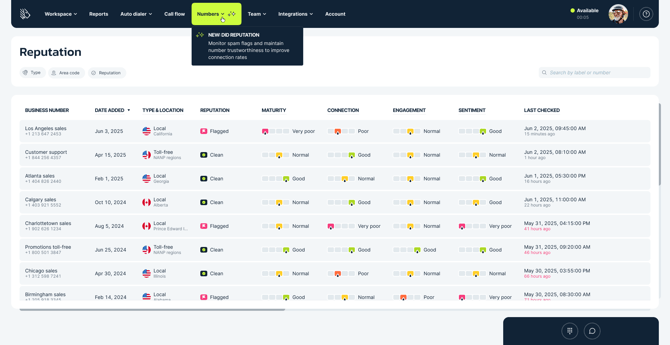
In total, there are 4 key number reputation scores provided as well: Maturity, Connection, Engagement and Sentiment. Each score will provide a summary of the phone number's standing, as Good, Normal, Poor, and Very poor. If a phone number has scores that are Poor or Very poor, this could reflect an issue in calling behavior that's causing bad engagement with the recipients, which might then lead to a label it as spam.
-
What it means: A number is considered "mature" either if it creates a higher volume of calls, or if it’s seen creating calls over multiple days/weeks (even at very low volumes).
-
How to use it: Phone numbers with little to no calling history can be a red flag for spam analytics systems, as it can indicate that the business is attempting to evade spam labeling by changing phone numbers. For a phone number with a poor maturity score, the businessshould establish themselves by using that phone number; making even a handful of calls makes a difference.
-
Follow-up questions:
-
Why hasn't this phone number been used? Is it new?
-
Was the number added to replace other numbers that were labeled as spam? If so, the underlying number reputation problem probably still needs to be addressed.
-
-
What it means: This score, based on the reactions of call recipients to the calls from this number, shows whether they tend to answer the phone when called from this number.
-
How to use it: If a phone number has a low connection score, it could mean recipients aren't finding the calls to be relevant to them. This can often be due to overly aggressive calling patterns such as calling too often, or continuing to call after the recipient gives an indicator they aren’t interested (like hanging up on a previous call). This is also one area where call branding can really assist: if a call is expected and wanted, it’s possible the recipient just doesn’t realize who is calling them.
-
Follow-up questions:
-
What is the policy for repeat calling to the same recipient? Policies that require a recipient to explicitly request to be removed from a calling list will lead to unanswered calls and poor connection.
-
For telesales, consider the integrity of any leads lists. Lists that are old or have minimal consent can lead to unexpected calls that then go unanswered.
-
Do recipients likely know who's calling? If calls have no branding, and/or are placed well after the recipient may have given consent, they may not realize who is calling or why it would be relevant to answer.
-
-
What it means: This score, based on the reactions of call recipients to the calls from this number, reflects if they tend to stay on the line when they answer the call. It can be an indicator that the recipients are engaging with the inbound call and having a meaningful conversation.
-
How to use it: Calls with low engagement may or may not indicate a problem. Some calls, like appointment reminders, will naturally have lower engagement from recipients since they aren’t meant to have a lengthy conversation. But for other types of calls, this usually is a clear indicator that recipients don't get value from the calls (especially if you find the recipient is the one hanging up). It is a major indicator of low-quality lead lists for sales-based services.
-
Follow-up questions:
-
Is there a lag before the calls are answered by an agent? Prolonged silence or messages asking the recipient to “please wait” usually end in a hangup.
-
Are your calling agents properly identifying themselves to the recipient? The recipient may already be suspicious the call will be spam and attempts at small talk can be met with "not interested" and a quick hangup.
-
-
What it means: This score, based on the reactions of recipients to calls from this number, reflects if they appear to want any lasting association with the caller. In particular, this can be a reflection if the recipients choose to block any future calls, possibly also raising a report against the caller.
-
How to use it: This is usually one of the strongest indicators about call quality for the recipients, because this score goes beyond calls being unexpected or inconvenient, but to being truly unwanted. Check for poor calling practices that would frustrate recipients (calling too often, calling on stale leads) and ensure that calls are reaching the right people who should get lasting value from a connection with the caller.
-
Follow-up questions:
-
What is the policy for repeat calling to the same recipient? Policies that require a recipient to explicitly request to be removed from a calling list will lead to recipients reporting or blocking future calls.
-
Are calls reaching recipients at appropriate times? A caller making irritating calls during dinner or early morning will quickly be blocked.
-